
This is a question that is asked by every engineering student in India at some point — generally at the end of the first week of college when there are a lot of seniors who are passionately advocating for entirely different answers.
Learn Python, bhai — It is the future. No, it’s Java that companies want. If you haven’t experienced C++, you don’t understand fundamentals. They are confused on what to choose among these, so here is an honest comparison – Python vs Java vs C++ for beginners.
I’ve been in this situation three times. Each time, I was more perplexed than I was the previous time.
So in this post, I’ll just put it straight — appropriately. Not with opinions, but rather with actual clarity about what each language is, to whom it is targeted, and which one is the best to learn first depending on the specific goal as an engineering student.
Let’s take a look at that.
First – Why This Question Even Matters
It’s not only about picking a programming language. It affects:
- The faster you see the results, the more you remain motivated
- Roles you can aim for as a fresher
- How easily you can switch to other languages later on
- Performance in campus placement tests
It will save you months of frustration if you get it right. It’s not the end of the world if you’re wrong, but it is a big waste of time if you aren’t.
Python – The Friendly Giant
What Python is?
Python is an open-source, high-level, general-purpose programming language that was developed in 1991. It’s always among the top programming languages in the world in 2026 — and not without good reason.
What Python Looks Like?
This is a simple Python program to say hello:
name = input(“What is your name? “)
print(f”Hello {name}! Welcome to programming.”)
Two lines. That’s it. Let’s look at an example of Java or C++, and you will realize why Python is the language for beginners.
Why Engineering Students Love Python?
Because Python is not only practical but also elegant, Python is not only functional but also classy!
Python has easy-to-read code that looks like plain English and has minimal “boilerplate” code. When new programmers begin writing their first coding project with Python, they only take a few minutes to write a working project!
It’s a big deal for novices. The hardest obstacle to overcome is discouragement when you’re just a beginner. Python is not only the fastest path to “it’s working!” as compared to any other language, but this upfront success is everything.
Where Python is used?
- Artificial Intelligence and Machine Learning — the main language in AI research.
- Data Science & Analytics
- Web Development using Django, Flask, and FastAPI.
- Automation and scripting
- Cybersecurity
- Cloud Computing (AWS, Google Cloud scripts)
Python and Indian placement drives
At the senior level, Python coders in the field of AI/ML can be paid between ₹20–35 LPA in 2026. Campus recruitment tests are more commonly being conducted in Python by product companies and startups.
Python’s honest weakness
Python runs the code sequentially and is not parallelized due to the Global Interpreter Lock (GIL). This means that Python is slower in terms of performance, but still adequate for many uses.
This is not an issue at all for most beginners and most use cases. As a student or early developer, you won’t normally hit Python’s limits of performance.
Python is right for you if:
- You are interested in AI, Machine Learning, or Data Science.
- You’re looking to get results quickly.
- You’re getting ready to do product company placements.
- You want to do repeatable stuff.
- You don’t know any programming languages at all.
Java — The Reliable Workhorse
What Java is?
Java is a strongly typed, object-oriented programming language for object-oriented applications that was introduced by Sun Microsystems in 1995. It was originally said that it would be “write once, run anywhere”, and for 30 years, it was.
What Java looks like?
The same greeting program is presented here, but in the Java programming language:
import java.util.Scanner;
public class Greeting {
public static void main(String[] args) {
Scanner scanner = new Scanner(System.in);
System.out.print(“What is your name? “);
String name = scanner.nextLine();
System.out.println(“Hello ” + name + “! Welcome to programming.”);
}
}
Notice anything? This requires a lot more code than Python. You need to import a library, make a class, write a main method, and make a Scanner object — to say hello. This is termed “boilerplate” and it is the largest hurdle for newcomers to Java.
However, there’s the thing about all that structure — you learn something that you didn’t in Python. It requires you to approach your problem-solving by using objects, classes, and structured programming concepts both from the start of the process and throughout the development.
Where Java is used?
- Enterprise software (banking, insurance, large corporations)
- Android app development
- Backend (Spring, Spring Boot) web development
- Big Data (Hadoop, Spark).
- Server-side applications
Java and Indian placement drives
Java continues to be in great demand for enterprise applications, backend development, and Android development. It is still a good and steady career path.
Today, majority of the service-based companies in India such as TCS, Infosys, Wipro, Cognizant and many others continue to rely on Java in their enterprise projects. As a fresher, knowledge of java is directly useful to you if you are targeting these companies.
Java’s honest weakness
Java is the “educational” language because it is verbose and the beginning is tedious. It’s easy to think programming is more difficult than it actually is when you have to write 10 lines of code only to print “Hello World”. Many beginners lose their heart when they start out because of that initial discouragement.
Java is right for you if:
- You’re looking to further your career in enterprise software / big companies.
- You’re targeting service based companies through campus placements.
- You would like to know how to build your own Android application.
- You’re okay with a longer learning period
- You want your OOP fundamentals strong
C++ — The Disciplinarian
What C++ is?
Bjarne Stroustrup created C++ in 1979; it is an extension of the C language. It is a compiled, statically-typed language with direct access to memory and hardware — very powerful and extremely unforgiving.
What C++ looks like?
In C++, the program that greets is:
#include <iostream>
#include <string>
using namespace std;
int main() {
string name;
cout << “What is your name? “;
cin >> name;
cout << “Hello ” << name << “! Welcome to programming.” << endl;
return 0;
}
More code than Python, somewhat cleaner than Java, but there’s a lot of things going on under the hood that you must learn and comprehend to code in C++ correctly, like memory management, pointers, etc.
Where C++ is used?
- Competitive programming (Codeforces, Leetcode, ICPC)
- Game development (Unreal Engine, AAA games)
- Systems programming (operating system, device driver).
- Embedded systems
- High-frequency trading
- Graphics engines
C++ and Engineering Colleges in India
It’s important to note that C and C++ are still taught in the first year of engineering in many colleges in India as foundation programming languages. It’s because of educational reasons, because C++ requires understanding how computers work at the low level, knowing about memory management, and knowing about pointers.
This basic information is really useful stuff. Students who have learned C++ will find Python and Java easier to learn later on because they understand what is going on.
C++ is important for competitive programming, software or system programming. There are still many recruiters who prefer a good understanding of C++.
C++’s honest weakness
It takes longer to write an acceptable program in C++ (weeks). Pointers, memory allocation, and destructors are concepts that are hard for students to grasp. C++ can make you feel like you don’t know your way around programming before you know what programming is.
C++ is right for you if:
- You want to truly enter into competitive programming (ACM ICPC, CodeForces)
- In the curriculum of your college, it is required (just go along with it)
- You are a gamer interested in programming or systems programming in general!
- You have a solid foundation in maths and love to solve problems at an in-depth level
- You prefer to have the deepest possible knowledge in computer science theory.
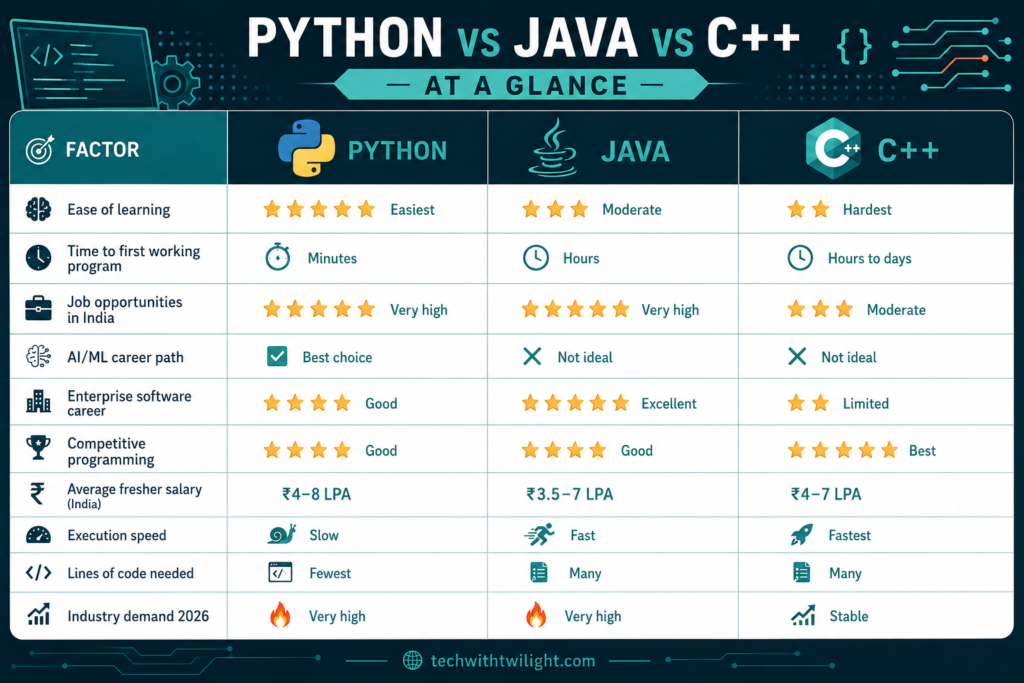
Python vs Java vs C++ for Beginners — Full Comparison
My Recommendation – Based on Your Goal
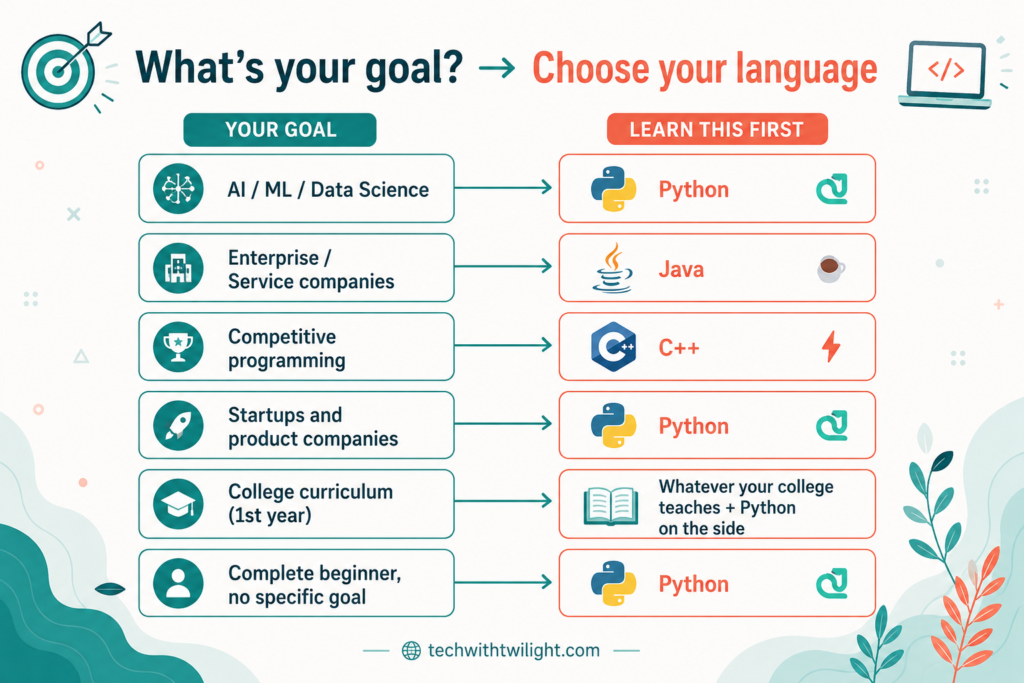
The straightforward response – depends on where you’re going:
If you want to get into AI, Machine Learning, or Data Science: Start with Python. No argument whatsoever. TensorFlow, PyTorch, Pandas, NumPy, Scikit-learn — it’s all in Python. If you want to be an AI Engineer / Data Scientist, go for Python, no doubts.
If you want to go into service companies like TCS, Infosys, Wipro, etc., Java is your best option. Most of the major IT Companies in India use Enterprise Java. Learn Java, get strong on OOPS concepts, and you are all set for Campus placement drives at these companies.
For competitive programming (ICPC, CodeForces, HackerRank): C++ is the standard language. The main reason most competitive programmers choose to program in C++ is its speed and its standard template library (STL). For competitive programming, the investment is right in C++.
For starting a company or a product company: Python then JavaScript. Python is gaining widespread popularity as the backend language and AI component of the modern startup stack in India. JavaScript for frontend. Java is not as prevalent in startups.
If C++ is required in your first year at college: Learn it, don’t fight the curriculum. Use it to learn the basics, with Python as an adjunct. By Year 2, you’ll have both!
The Truth Nobody Tells You
One thing I wish I had been told when I was trying to answer this question:
You are not your first language. It takes only a small fraction of the time to learn a second language after learning the first one thoroughly- that is, the concepts, data structures, logic, and problem-solving. The fundamentals are the same. The syntax is just the details.
There are developers I talk to who use C++ to start and then went into Java and now code in Python for a living. There are developers out there who began with Python and now move to Go. No one is “locked in”. There is no “locked in” to begin with.
As an engineering student, you have lots of time to study these languages on your own. Start with Python; it gives you opportunities. Then, you will learn C++ or Java according to your interests.
The language you use is just the beginning. You should think in terms of solving problems and creating things — what companies look for.
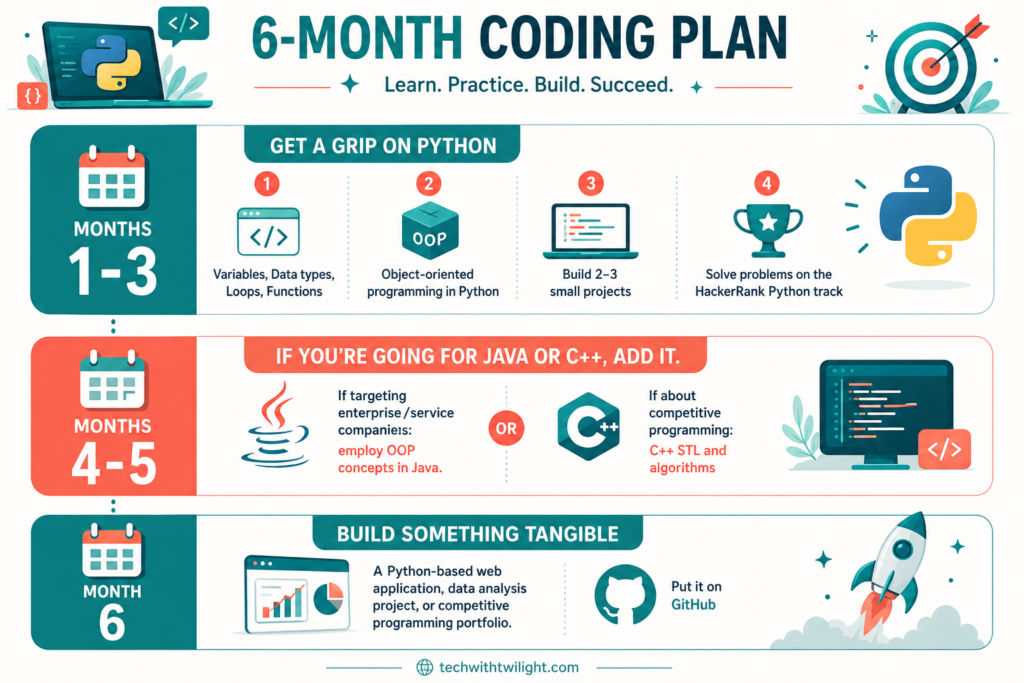
The 6-Month Learning Path (My Personal Recommendation)
Based on all of the above, here’s what I would say to a friend starting out in 2026:
Months 1-3: Get a grip on Python.
- Variables, Data types, Loops, Functions
- Object-oriented programming in Python.
- Build 2–3 small projects
- Solve problems on the HackerRank Python track.
Months 4-5: If you’re going for Java or C++, add it.
- If targeting enterprise/service companies: employ OOP concepts in Java.
- If about competitive programming: C++ STL and algorithms
Month 6: Students will build something tangible.
- A Python-based web application, data analysis project, or competitive programming portfolio.
- Put it on GitHub
By Month 6, you’ll have a strong foundation in Python and a second language that will enrich your skills. You will be better equipped to go for placements than most of your classmates who have been pondering what language to learn for 6 months.
Final Verdict
| Your Goal | Learn This First |
| AI / ML / Data Science | Python 🐍 |
| Enterprise / Service companies | Java ☕ |
| Competitive programming | C++ ⚡ |
| Startups and product companies | Python 🐍 |
| College curriculum (1st year) | Whatever your college teaches + Python on the side |
| Complete beginner, no specific goal | Python 🐍 |
The default answer for most engineering students in 2026 is Python — it’s the easiest to start with, has the widest application, and has the highest demand in the fastest-growing areas of tech.
But no matter which language you choose — start today. The best programming language is the one you’re actually writing code in.
What was your first language? If you could do it again, would you do it differently? Leave a comment – I really do want to know!
Related Posts: